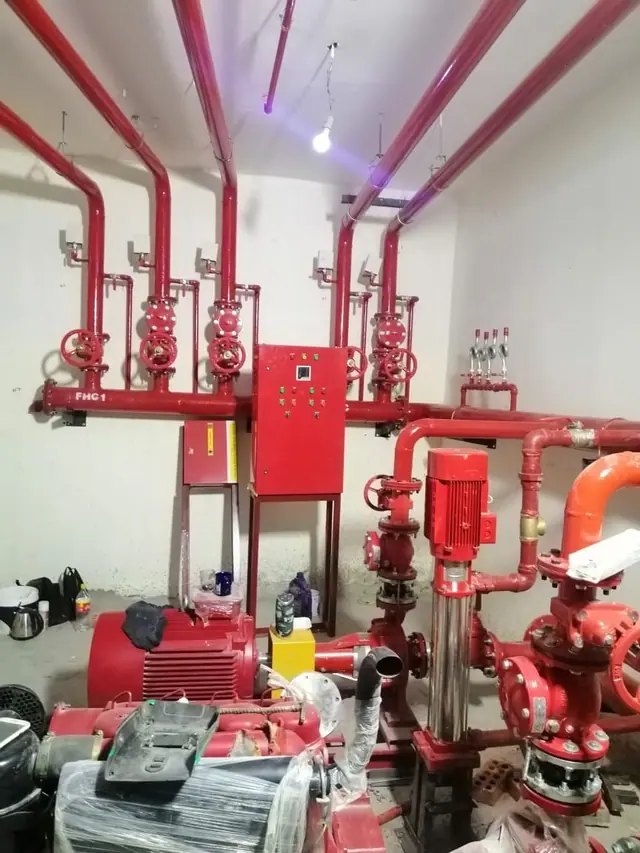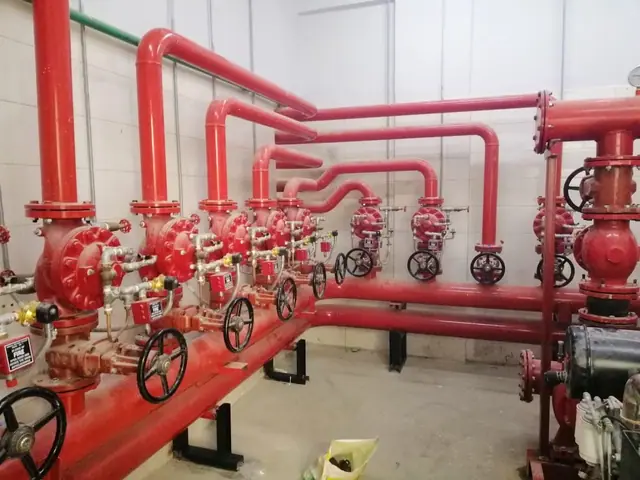
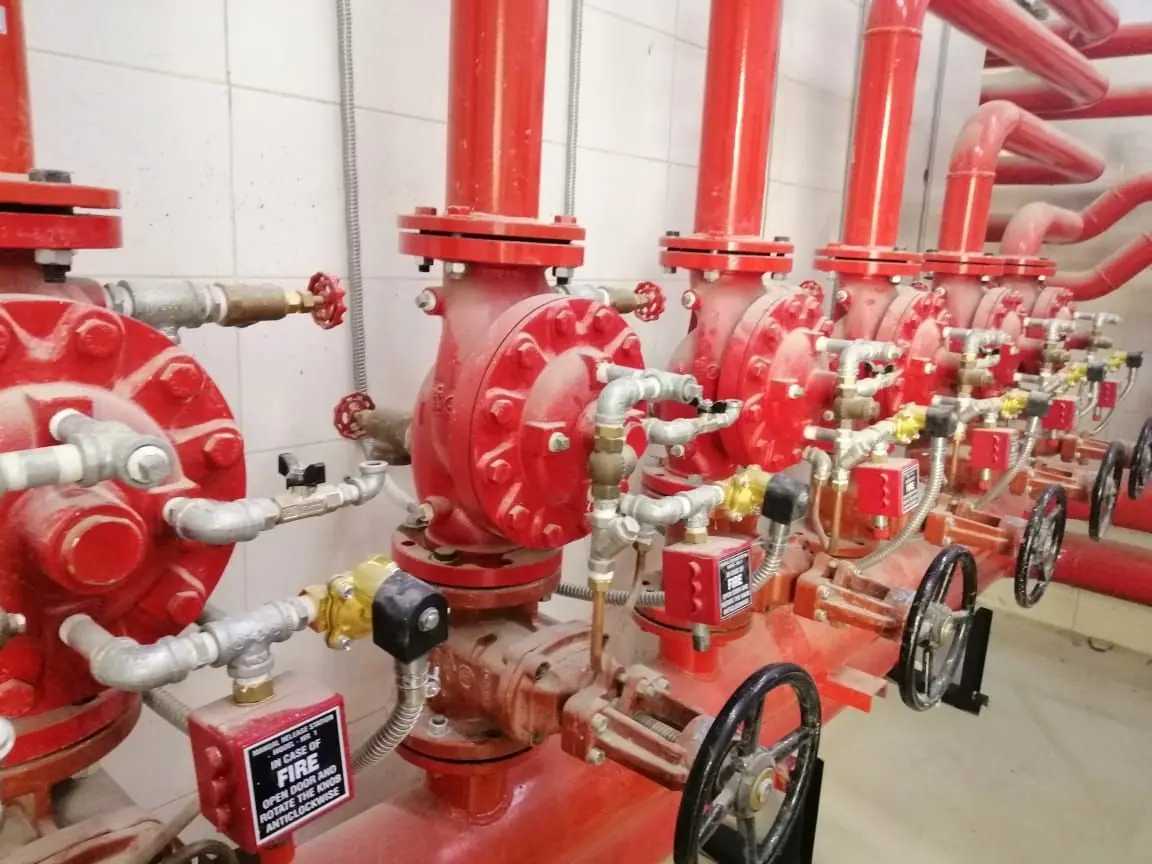
A fire pump room holds everything that turns stored water into water at the pressure a fire network needs. A typical room contains a main pump, a standby pump, a jockey pump, their controllers, suction and discharge piping, valves, gauges and a test line. NFPA 20 is the standard most often used for this equipment, while the exact layout comes from the approved design.
If you own or run a facility, knowing what each part does makes it far easier to spot a problem before it matters.
Quick reference: pump room components
| Component | What it does | What to look for |
|---|---|---|
| Main fire pump | Delivers firefighting flow and pressure | Starts automatically, no leaks |
| Standby pump | Takes over if the main pump or its power fails | Set to automatic |
| Jockey pump | Holds network pressure, makes up small leaks | Not cycling too often |
| Pump controllers | Start pumps and show status | Automatic mode, no alarms |
| Suction valve | Isolates the pump from the water source | Fully open and secured |
| Check valve | Stops water flowing back through the pump | Holds pressure when stopped |
| Discharge valve | Isolates the pump from the network | Fully open and secured |
| Pressure gauges | Show suction and discharge pressure | Readable and plausible |
| Relief valves | Protect the pump and system from excess pressure or heat | No constant discharge |
| Test line or flow meter | Allows measured flow tests | Accessible, valve closed |
The pumps
Main fire pump
This is the pump that does the real work once a sprinkler opens or a hose is used. It is selected for the flow and pressure the system demands, based on hydraulic calculations. Horizontal split case pumps are common where the water level sits above the pump. Where the water source is below the pump, such as a deep tank or a well, a vertical turbine pump is the usual solution. Our fire pump guide explains how to choose between pump types.
Standby pump
Many installations add a second pump, driven by a diesel engine or by a separate electric supply. The goal is simple: protection should survive the loss of one pump or one power source. The standby arrangement is set by the design and the authority’s requirements.
Jockey pump
The jockey pump, also called a pressure maintenance pump, is small. It keeps the network full and at pressure and makes up tiny leaks, so that the main pump does not start every time pressure dips a little. It is not a fire pump, and its flow is not counted toward firefighting demand.
Controllers and power
Fire pump controllers
Each pump has its own controller. It starts the pump automatically when network pressure falls, allows manual starting, and displays the pump’s status. NFPA 20 expects controllers listed for fire pump service, because they behave differently from ordinary motor starters. The aim of a fire pump controller is to keep the pump running when a normal starter would trip to protect the motor.
Pressure sensing lines
Small pipes connect the network to each controller so that it can read system pressure. They are easy to overlook, yet a blocked or shut sensing line means the pump may never get the signal to start.
Power supply and signals
Electric fire pumps need a reliable, protected feed that stays live when other parts of the building are shut down. Controllers normally send signals to the fire alarm panel, such as pump running, power failure and fault conditions, so a problem is seen at the panel and not just in the pump room.
The suction side
Suction piping brings water from the tank to the pump. Its design has a direct effect on pump performance and life:
- Isolation valve. Allows servicing, and should be secured open and monitored.
- Eccentric reducer. Joins the suction pipe to the smaller pump inlet with its flat side on top, so that air pockets do not form.
- Compound gauge. Reads pressure on the suction side, including readings below atmospheric pressure.
- Strainer. Used where the water source may carry debris.
The tank connection matters too, because the pump can only deliver what the supply allows. See our guide to fire water tank sizing.
The discharge side
- Pressure gauge. Shows the pressure the pump is producing.
- Check valve. Keeps network pressure from pushing water back through the pump.
- Discharge isolation valve. Lets you take a pump out of service without draining the network.
- Circulation relief valve. Passes a small flow while the pump runs against a closed system, which stops the casing from overheating.
- Main relief valve. Used where the design calls for it, for example where pressure could exceed what the system components are rated for.
- Air release valve. Fitted where the pump type requires it, to let trapped air escape.
The test line
A pump can look healthy for years and still be unable to deliver its rated duty. A test header or flow meter lets you measure actual performance at no-flow, rated flow and peak flow without pushing water into the network. The test water must be directed somewhere safe, such as back to the tank or to a drain with enough capacity. NFPA 25 sets out how flow testing is carried out over the pump’s life.
Extra items for diesel pumps
A diesel-driven pump adds its own support systems:
- Fuel tank and fuel lines
- Starting batteries and chargers, usually in duplicate
- Engine cooling arrangement
- Exhaust piping routed safely outdoors
- Enough combustion and cooling air
The room itself
The room is part of the system. It should be separated from surrounding risks, ventilated, drained, lit, and reachable during a fire. Leave space to maintain each pump and to operate each valve. Avoid using it as a store. Outdoor pump sets, which are also seen on industrial sites, need weather protection and security in place of these room features.
How the parts work together
In normal conditions, the jockey pump holds pressure and everything else waits. When a sprinkler opens, pressure falls faster than the jockey can recover. The controller senses the drop and starts the main pump. If that pump fails to deliver, the standby pump starts. Check valves keep water moving toward the fire, and the pump is commonly left running until someone stops it at the controller after the fire is under control. Exact settings come from the approved design.
Most failures are simple ones: a controller left in manual, a closed valve or a flat battery. A regular routine catches them, and our maintenance checklist shows what to include.
Planning or upgrading a pump room
ECCO designs, supplies and installs fire pump rooms for facilities across Egypt, and we are agents for SUZLER pumps. Browse the range on our products page, or contact our engineers to review your pump room.
Frequently asked questions
What is the difference between a main fire pump and a jockey pump?
The main pump supplies the flow needed to fight a fire. The jockey pump is a small pump that keeps the network pressurized and makes up small leaks, so the main pump does not start without need.
Why does a pump room need a test line?
A test line lets you measure the pump's real flow and pressure without discharging water through the fire network. Without it, you cannot properly confirm the pump still meets its design duty.
Do I need a diesel pump as well as an electric pump?
It depends on how reliable your power supply is and on the approved design. Many projects use a second independent pump so that protection continues if one pump or power source fails.
Which standard covers fire pump installation?
NFPA 20 is the standard most widely used for installing stationary fire pumps, and NFPA 25 covers their inspection, testing and maintenance. Local requirements follow the Egyptian fire code and the Civil Defense authority.