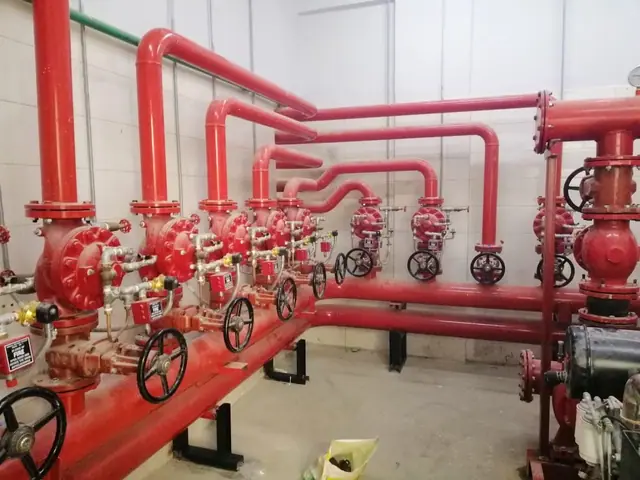
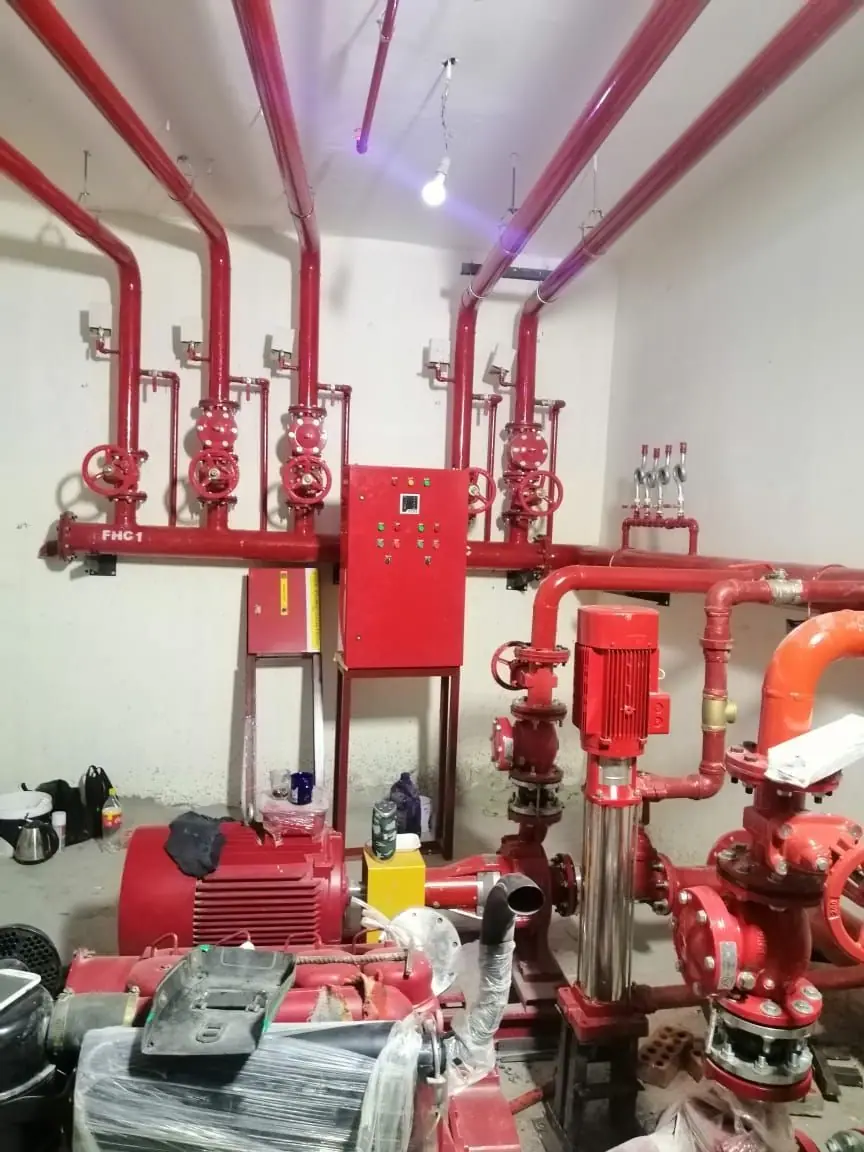
A fire pump set raises the flow and pressure of the water supply to the level a fire protection system needs. A typical set has three parts: an electric main pump, a diesel pump that works without the electrical network, and a small jockey pump that holds the system at pressure. When a sprinkler opens or a hose is used, pressure drops and the pumps start in a planned sequence.
Fire pumps are installed under NFPA 20, the standard for stationary fire pumps. This guide explains what each pump does, how they work together, and what to check when you select one.
The three pumps in a typical fire pump set
Electric fire pump
The electric pump is often the lead pump. It is simple, compact and needs relatively little routine upkeep. Its weakness is that it depends on electricity at the exact moment a fire may have damaged the supply. For that reason, the power feed to a fire pump deserves careful design, and it is normally routed and protected separately from general building loads.
Diesel fire pump
A diesel pump carries its own energy source, which makes it independent of the electrical network. This is valuable where the supply cannot be treated as dependable, or where the design calls for a second independent source. The trade-off is a more demanding installation. A diesel set needs a fuel tank, starting batteries, room ventilation, an exhaust route and a regular running routine.
Jockey pump
A jockey pump, also called a pressure maintenance pump, is a small pump that holds the network at standby pressure. Every piping network loses a little pressure over time through minor leaks and small changes in temperature. Without a jockey pump, those small losses would start the main pump again and again. It is not counted as part of the firefighting supply.
Electric, diesel and jockey pumps compared
| Feature | Electric pump | Diesel pump | Jockey pump |
|---|---|---|---|
| Role | Main firefighting supply | Main or backup firefighting supply | Maintains standby pressure |
| Energy source | Electrical supply | Diesel fuel and batteries | Electrical supply |
| Works during a power failure | Only with a suitable alternative source | Yes | Not required to |
| Installation needs | Reliable power feed | Fuel, ventilation, exhaust | Sensing line and controller |
| Routine testing | Regular no-flow runs and flow tests | More frequent no-flow runs and flow tests | Checked with the pump set |
How the pumps work together
Each pump is controlled by its own pressure setting, and the settings are staggered so that the pumps start in order:
- Standby. The network sits at its set pressure and all pumps are stopped.
- Small pressure drop. A minor loss brings the jockey pump on. It restores the pressure and stops automatically.
- Larger pressure drop. When water starts flowing through a sprinkler or hose, the jockey pump cannot keep up. Pressure falls to the start setting of the lead pump.
- Backup start. If the lead pump fails to start or pressure keeps falling, the next pump starts at its lower setting.
- Shutdown. Main fire pumps are commonly stopped by hand at the controller once the fire is under control, and only after the responsible person has confirmed it is safe.
If the jockey pump runs very often, treat it as a warning. Frequent starts usually point to a leak or a fault in the network.
Pump types you will see in a pump room
The term “fire pump” describes the duty, while the pump construction varies:
- Horizontal split case pumps suit higher flows and are easy to service, and they are usually fed by a tank with water above the pump centerline.
- End suction pumps are compact and common on smaller systems.
- Vertical turbine pumps are used when the water source sits below the pump, such as a well or an underground reservoir.
- Vertical multistage pumps are commonly used for jockey duty, where a high pressure and a low flow are needed.
The pump room also matters as much as the pump itself. Suction piping, valves, test connections and controllers all affect whether the set performs as designed. See our guide to fire pump room components for the full layout.
What to check when selecting a fire pump
- Rated flow and pressure. These must come from hydraulic calculations, not an estimate.
- Water supply. The tank must hold enough water for the required duration. Read more about fire water tank sizing.
- Suction conditions. The pump arrangement must match the position of the water source.
- Pump performance. Review the curve at the rated point, at no-flow and at overload.
- Controllers. Fire pumps use dedicated controllers, not ordinary motor starters.
- Documentation. Ask for test data and any listing or approval documents, and check them against what the project specification and the authority require.
- Testing provisions. The design should allow flow testing without improvising after handover.
Exact requirements depend on the approved design and on Civil Defense. A pump that looks right on a data sheet can still fail an acceptance test if the installation around it is wrong.
Common fire pump installation mistakes
Many performance problems come from the installation rather than the pump itself. These are among the most frequent on site:
- Poor suction piping. Undersized pipe or badly placed fittings near the pump inlet disturb the flow and reduce performance.
- Controllers not made for the duty. Ordinary motor starters do not perform the functions of a fire pump controller.
- No way to test flow. Without a suitable test connection, it is hard to verify the pump at acceptance or during maintenance.
- Controllers left in manual. A controller left off or in manual after servicing will not start the pump automatically.
- Weak ventilation in a diesel pump room. The engine needs enough air for combustion and cooling.
- A shared tank without a protected reserve. If the fire volume is not secured, the tank may be short when a fire happens.
Most of these are easy to avoid when a specialist engineer reviews the drawings before work starts and attends the commissioning tests. Correcting a finished pump room usually costs far more than getting it right the first time.
Keeping a fire pump ready
A fire pump may sit idle for years and then be needed without warning. Regular running, flow testing and upkeep of batteries, fuel and controllers are what make it dependable. NFPA 25 covers this work, and our fire system maintenance checklist sets out what to inspect and how often.
ECCO is an agent for SUZLER pumps, and our range includes fire pump sets and related pump types. You can browse them on our products page.
Need help with a fire pump set?
Whether you are designing a new pump room or replacing an existing set, contact ECCO. Share your drawings or site details, and our engineers will review the requirements with you.
Frequently asked questions
What is the difference between a main fire pump and a jockey pump?
The main fire pump delivers the flow and pressure the fire system needs during a fire. The jockey pump is a small pump that keeps the network pressurized and makes up for minor pressure losses, so the main pump does not start unnecessarily. It is not sized to fight a fire.
Do I need both an electric and a diesel fire pump?
Not always. A diesel pump gives a supply that does not depend on the electrical network, so it is common as a main or backup pump. The right arrangement depends on the reliability of the power supply, the approved design and the requirements of the local authority.
Why does a fire pump keep running after the pressure recovers?
Main fire pumps are commonly arranged to be stopped manually at the controller after an automatic start, so that a pump cannot shut down during a fire. The exact arrangement depends on the controller and the approved design.
How is the size of a fire pump determined?
The rated flow and pressure come from the hydraulic calculations for the protected systems, together with the available water supply and the height of the building. A pump should not be selected from a rule of thumb.