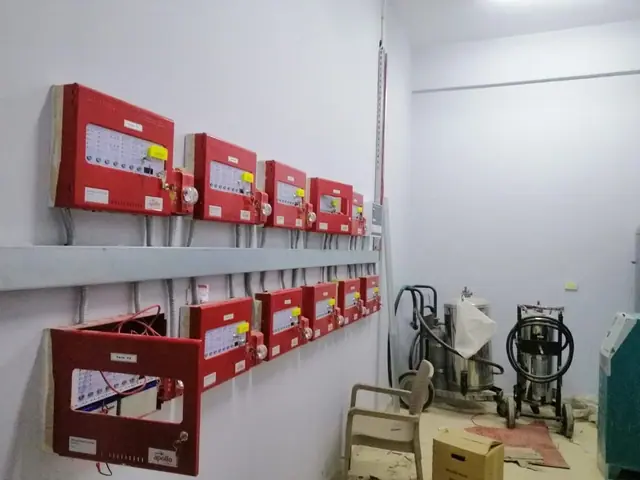
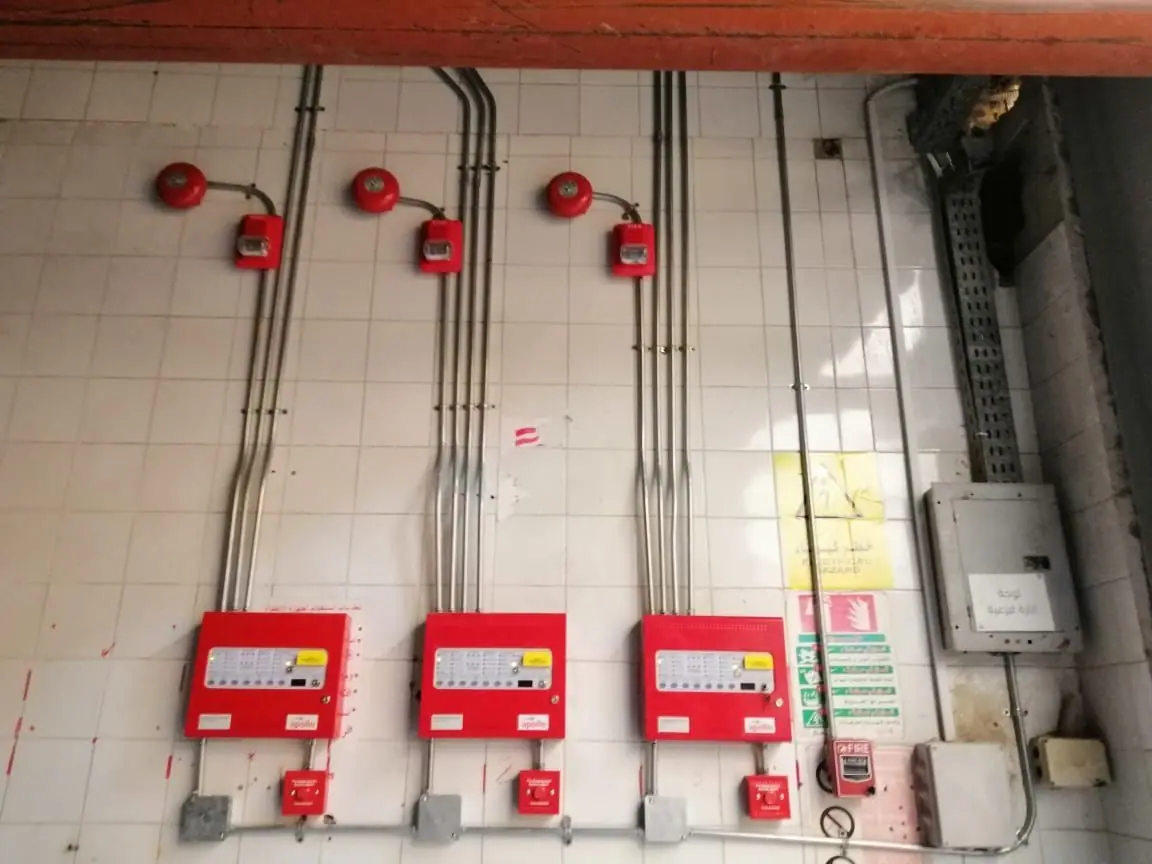
The difference comes down to how precisely the system reports a fire. A conventional fire alarm tells you which zone is in alarm. An addressable fire alarm tells you exactly which detector or device has activated. As a general guide, conventional systems suit small, simple buildings, and addressable systems suit larger or more complex sites where finding the source quickly matters.
Both types can be valid solutions when designed correctly. The sections below explain how they differ and how to decide.
How a conventional fire alarm works
In a conventional system, detectors and manual call points are wired on circuits, with each circuit covering one zone, such as a floor or part of a building. When a device activates, the panel shows that the zone is in alarm but cannot tell which device triggered it. Someone then has to walk the zone to find the source.
Each circuit ends with an end-of-line device, which lets the panel monitor the wiring for faults. Conventional systems are simple to understand and service, and for a small site they are usually the most economical option.
Their limits appear as a building grows. More zones mean more circuits and more cable back to the panel, and the information stays general. Maintenance staff may also spend time tracing a fault or a false alarm across an entire zone.
How an addressable fire alarm works
In an addressable system, every device has its own unique address and shares a loop with other devices. The panel communicates with each device in turn, so it knows the status of each one and shows the exact location in the event of an alarm or fault.
Many addressable systems add useful features:
- Precise location: the panel can display a text label such as a room or area name.
- Loop wiring: a loop can continue to communicate after a single break, because the panel can reach devices from both ends. Isolators limit the effect of a short circuit.
- Programmable cause and effect: the panel can be set to run specific actions for specific devices, such as closing fire dampers or releasing doors.
- Drift and contamination reporting: analog addressable detectors can flag when they are getting dirty, so they can be serviced before they cause a false alarm.
- Integration: panels can often connect to each other and to other building systems.
The trade-offs are a higher equipment cost, the need for programming during commissioning, and devices that are usually tied to one manufacturer’s protocol. Before you commit, ask how spare parts, programming software and future service will be handled.
Conventional vs addressable fire alarm: side-by-side comparison
| Factor | Conventional | Addressable |
|---|---|---|
| Alarm information | Zone only | Exact device and location |
| Wiring | Separate circuit for each zone | Shared loops with many devices |
| Finding the source | Manual search of the zone | Shown on the panel |
| Effect of a cable break | Can affect devices beyond the break | Loop can keep working if properly wired |
| Programming | Minimal | Required during commissioning |
| Equipment cost | Lower | Higher |
| Expansion | Limited by zones and panel size | Easier within loop capacity |
| Interchangeable devices | Generally wider choice | Usually manufacturer-specific |
Which system should you choose?
When a conventional system can make sense
- Small shops, workshops and small offices.
- Buildings with a simple layout that is easy to search.
- Sites where a small number of zones can cover the whole building.
- Projects where the approved design accepts it and the budget is tight.
When an addressable system is usually the better choice
- Hospitals, hotels and other buildings where evacuation has to be managed carefully.
- Factories, warehouses and large commercial buildings.
- Multi-storey buildings and sites with several connected buildings.
- Any site where the alarm must trigger other systems, such as a gas suppression release or a smoke control sequence.
- Facilities that expect to expand.
Questions to ask before deciding
- How long would it take your team to locate a detector in a zone during an alarm?
- How much would a false alarm cost in production or evacuation time?
- What will the alarm need to control besides the sounders?
- Who will service the system, and can they get spare parts?
- What does the approved design require?
Compare total cost rather than panel price alone. On a large site, the cable saved by shared loops and the time saved in finding faults can offset part of the higher equipment cost. On a small site, an addressable system may add cost without adding much value.
The right devices matter too. Detector selection depends on the fire risk and on conditions in each area, such as dust, steam or high ceilings. Our guide to fire detector types explains the options. It is also worth seeing where the alarm fits in the wider design, as explained in our guide to fire protection systems.
Combining both systems and upgrading existing sites
The decision is not always one or the other. Many addressable panels accept interface modules that connect a zone of conventional detectors to the loop. This is a practical option when extending an existing building, or when keeping a sound part of an old system for a transition period. That part still appears as a single zone, so it does not gain the same precision. Compatibility varies by manufacturer, so confirm it before relying on it.
When upgrading an existing system, review these points:
- Cable condition. Check the type, insulation and routes, because not all older cabling suits an addressable loop.
- Detector coverage. The use of the space may have changed since the first installation.
- Protection during the work. Plan the changeover in stages, and put temporary measures in place wherever protection is interrupted.
- Documents. Update the drawings, zone descriptions and cause and effect matrix.
False alarms remain a design and maintenance issue in both systems. The wrong detector type or a build-up of dust can cause them, however advanced the panel may be.
Standards and approvals
NFPA 72 is the main reference for designing, installing and testing fire alarm systems, and the EN 54 series covers the equipment. Which standard applies to a project depends on the approved design, the Egyptian fire code and the requirements of Civil Defense. Once a system is running, it needs regular testing, as described in our fire system maintenance checklist.
Fire alarm systems from ECCO
ECCO designs, supplies, installs and maintains fire alarm systems, and is an agent for ASSS, the Egyptian manufacturer of NEVERFIRE fire alarm systems. Learn more on our products page.
Not sure which system fits your building?
Contact ECCO with your drawings or a short description of the site. Our engineers will review your requirements and recommend a suitable fire alarm system.
Frequently asked questions
What is the main difference between conventional and addressable fire alarms?
A conventional system reports which zone is in alarm, while an addressable system reports the exact device. In a conventional system, staff must search the zone to find the source. In an addressable system, the panel identifies the device and its location.
Is an addressable fire alarm always better?
Not always. Addressable systems give more information and flexibility, but a small building with a few zones may be served well by a conventional system. The choice should follow the size and risk of the building and the approved design.
Can a conventional system be upgraded to addressable?
Usually the panel and detectors must be replaced, because the two systems use different devices. Some existing cabling may be reusable, but this has to be checked by an engineer, since addressable loops have their own wiring needs.
Which standards apply to fire alarm systems?
NFPA 72 and the EN 54 series are widely used references. The standard that applies to your project is set by the approved design and the requirements of Civil Defense, alongside the Egyptian fire code.